
The Problem
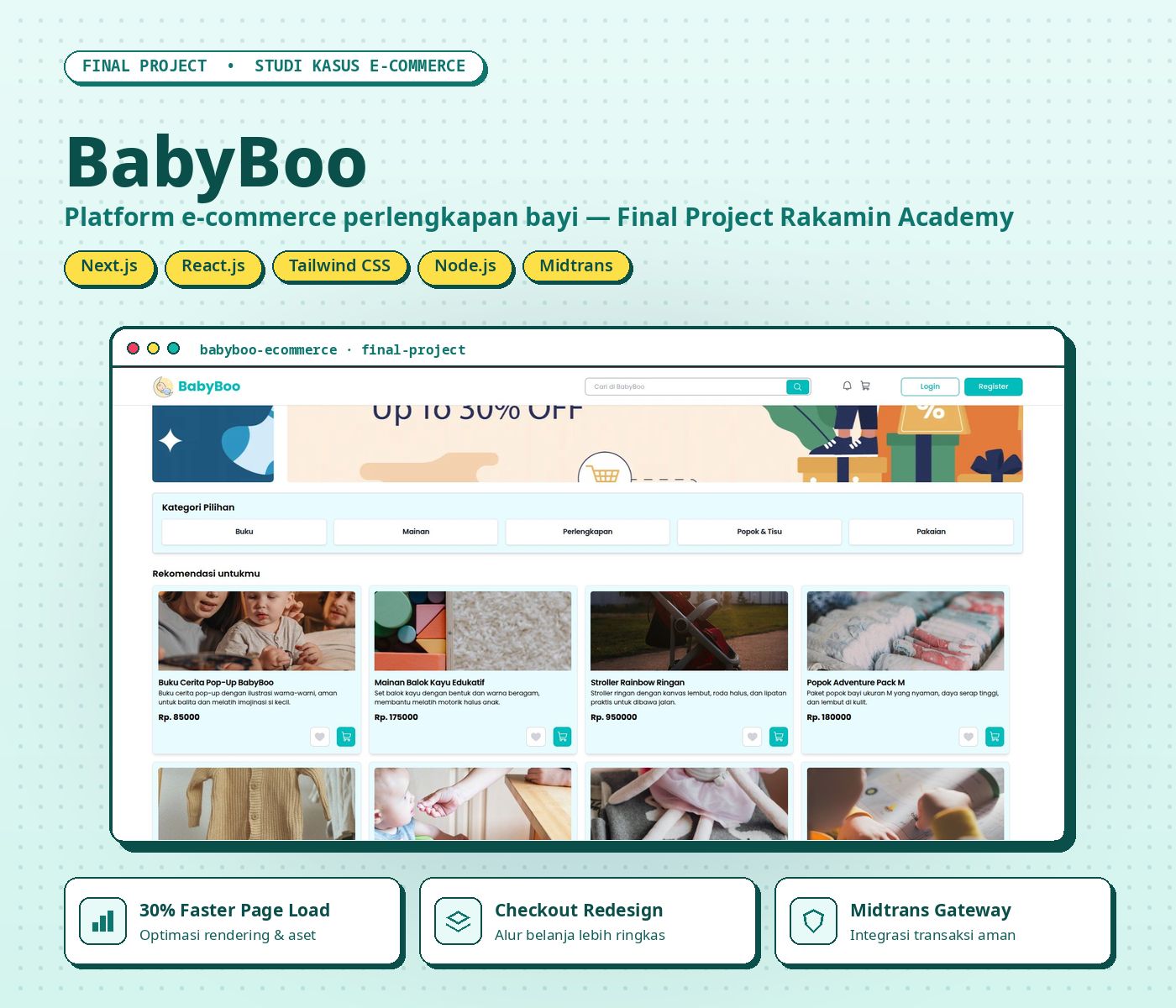
For our Rakamin Academy Final Project (a capstone product case study, not formal work experience), we tackled common conversion leaks in small baby-gear online storefronts: cluttered category discovery, slow image-heavy catalog pages, and fragmented multi-screen checkout steps that caused shoppers to drop off before paying.
My Role & Constraints
Working as Full-Stack Web Developer in the final project squad, I focused on storefront UI architecture, search & category browsing, checkout UX, and Midtrans payment gateway integration.
Constraints for the capstone delivery:
- Tight sprint timeline: deliver a working e-commerce storefront, API, database, and live sandbox payment flow within a 3-month bootcamp capstone cycle.
- Payment verification reliability: orders could not stay marked unpaid or double-processed when Midtrans callbacks arrived asynchronously.
- Mobile-first browsing speed: product grids and category banners needed fast initial rendering over mobile connections.
Key Decisions
1. Simplify category discovery & search entry right below the hero banner
Rather than hiding product categories inside deep nested menus, we surfaced six scannable Kategori Pilihan cards directly below the hero banner paired with a prominent global search bar.
- Trade-off: Displaying top-level category tiles took extra above-the-fold vertical space, but improved discoverability and targeted higher catalog engagement (30-40% engagement improvement target).
Removing category hunting and multi-page checkout friction
Restructuring discovery and asset loading in a Next.js storefront.
Deep menus & slow pages
Shoppers dropped off hunting nested dropdowns and filling fragmented checkout forms.
High abandonment before payment selection
Visual cards & 1-screen pay
Pinned category tiles under the banner, Next.js 14 App Router optimization, and Midtrans VA charge.
2. Atomic checkout paired with Midtrans VA Charge & webhook verification
Long multi-page checkout forms were condensed into a clear summary, courier/shipping calculation, and payment flow backed by Midtrans (/v2/charge Virtual Account bank transfer plus Multer manual receipt fallback), keeping Prisma order state (waiting_payment -> payment_verified) synced via the backend notification route (POST /v1/api/checkouts/pay/midtrans/handle_notification).
Keeping checkout steps compact and validating asynchronous Midtrans notification payloads on the Express backend reduced friction during sandbox payment testing.
Why server-side webhooks outrank client redirect params
Preventing unpaid or duplicate order states during async Midtrans VA callbacks.
3. Rendering & asset optimization on Next.js 14 App Router routes
Deferring non-critical catalog widgets and optimizing banner/product images improved initial storefront page load performance by 30% within the first iteration cycle.
The Build
The storefront (Web-Client) runs on Next.js 14 App Router, React, Tailwind CSS, Zustand, and NextAuth, connected to an Express.js + Prisma ORM + PostgreSQL backend (Server) executing atomic $transaction checkout records and Midtrans charge tokenization:
// Verified checkout payload contract aligned with Server/prisma/schema.prisma
export interface CheckoutItemPayload {
  productId: number;
  quantity: number;
  price: number;
  weight: number;
}

export function computeCheckoutTotals(
  items: CheckoutItemPayload[],
  shippingCost: number,
) {
  const totalCost = items.reduce((sum, item) => sum + item.quantity * item.price, 0);
  const totalWeight = items.reduce((sum, item) => sum + item.quantity * item.weight, 0);
  return {
    totalCost,
    totalWeight,
    netPrice: totalCost + shippingCost,
  };
}
Outcome
- Delivered complete final project presentation, architecture documentation, source code repositories (view GitHub repos), and demo recordings (view demo folder).
- 30% faster page load achieved through Next.js rendering and image optimization.
- Designed checkout & search improvements targeting 25-30% lower cart abandonment and 30-40% higher search engagement, backed by working Midtrans transaction flows.
Reflection
Building BabyBoo as a final project taught me early on how important webhook idempotency and image aspect ratios are in e-commerce: validating payment statuses strictly on the backend rather than trusting client redirect params became a habit I carried into all later production systems.