
The Problem
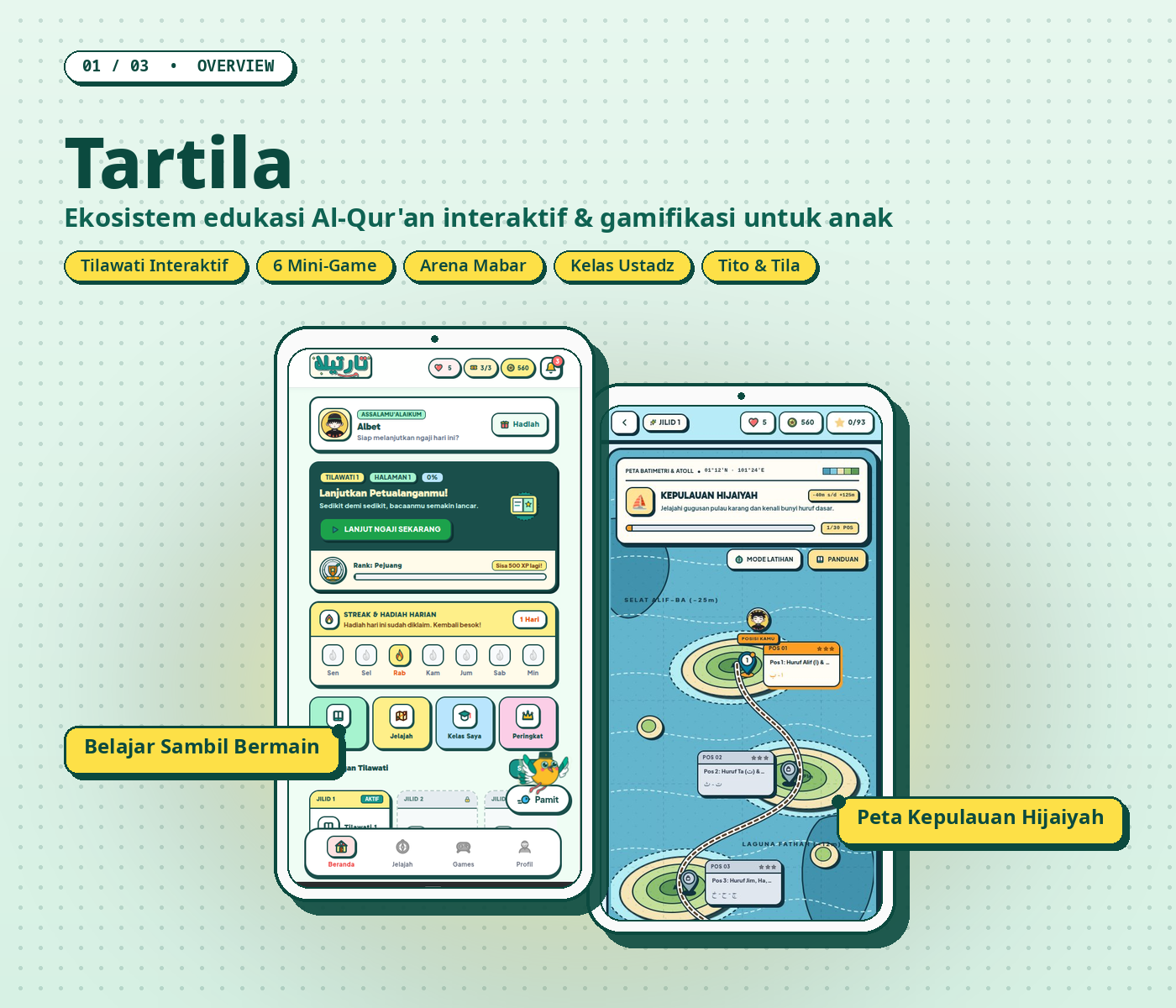
Most digital Quran learning tools for children feel like digitized PDF books, with static audio playback, minimal feedback loops, and no clear sense of progression. Parents and Ustadz wanted a web-accessible space where kids stay engaged across structured Tilawati reading stages while teachers can still track real learner mastery.
Building that as a solo founder meant balancing rich interactivity (expressive vector mascot rooms, 6 responsive 2D mini-games, live multiplayer) against strict performance budgets on mid-range mobile browsers.
My Role & Constraints
As Founder & Full-Stack Engineer, I owned product framing, UI/UX flows, interactive game and mascot engineering, Go Fiber backend APIs, PostgreSQL data modeling, and production deployment.
Three constraints shaped the architecture:
- Responsive PWA on mobile & classroom tablets: interactive 2D mini-games and customizable SVG mascot screens needed smooth frame pacing without bloating initial bundle load.
- Reliable state across solo & multiplayer modes: real-time arena rooms could tolerate transient WebSocket updates, whereas learner progress, badges, and Ustadz assessments required strict relational consistency.
- Solo engineering velocity: shipping an entire ecosystem (learning paths, 6 released 2D mini-games, interactive Tito & Tila companion customization, and an Ustadz dashboard) demanded tight schema contracts and disciplined AI-assisted coding workflows.
Key Decisions
1. Hybrid backend: Go Fiber + PostgreSQL as SSOT, Ably PubSub + HTTP Snapshots for real-time arena
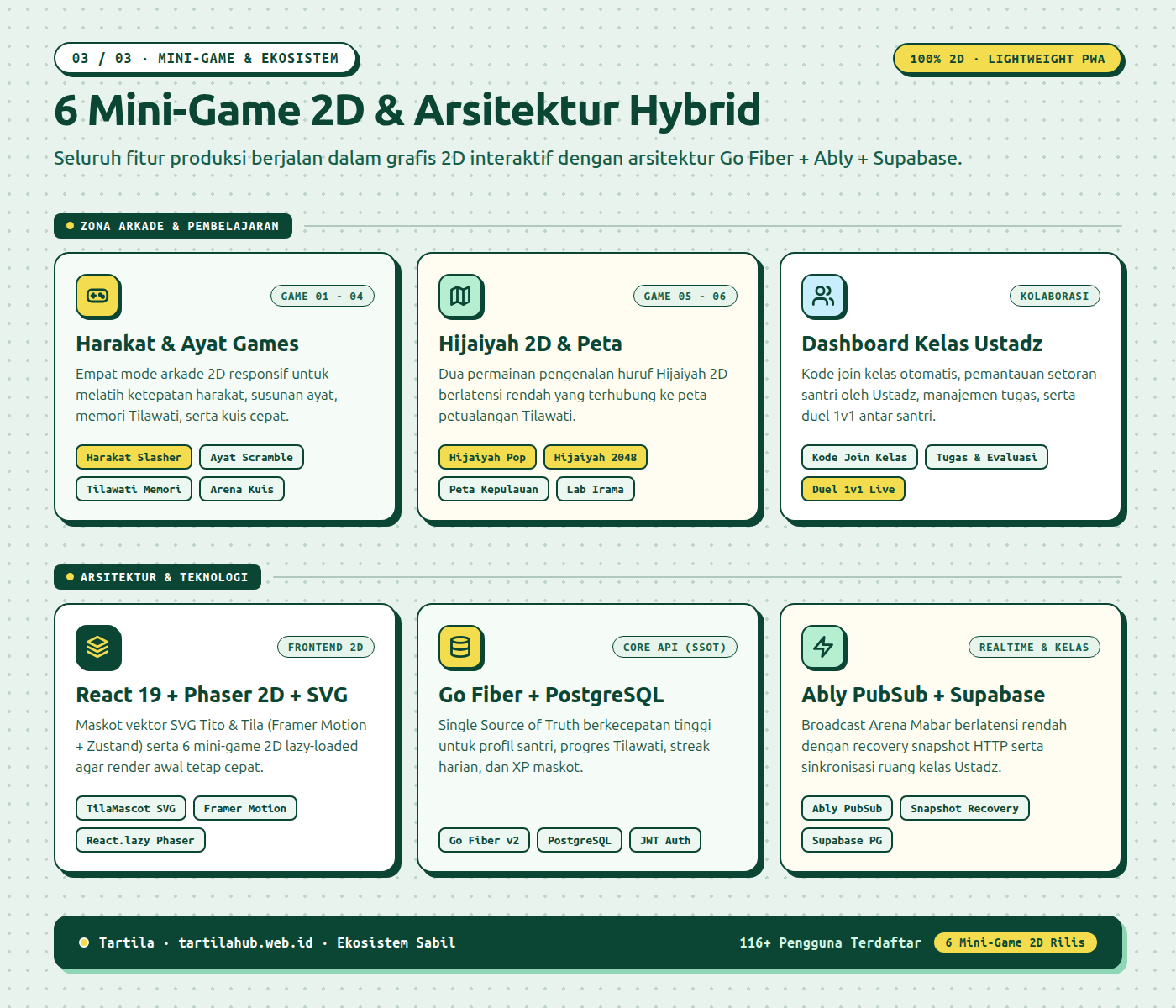
Rather than forcing every interaction through one persistence layer, we split responsibilities strictly across three boundaries: Go Fiber + PostgreSQL serves as the exclusive Single Source of Truth (SSOT) for user authentication, profiles, and Tito & Tila mascot preferences (GET /api/v1/user/profile, PATCH /api/v1/user/mascot); Go Fiber WebSocket Hub + Ably PubSub (room:{pin} & match:{sessionId} with server-side eventSeq/stateVersion and HTTP /state recovery snapshots) drives low-latency Lobi Mabar arena broadcasts; and Supabase PostgreSQL stores classroom assignments, Ustadz rooms, and game economy state without duplicating user identity tables.
- Trade-off: Coordinating Ably ephemeral broadcasts with Go HTTP state snapshots required explicit reconnect recovery (
refreshsafe), but it kept live classroom matches resilient while protecting user identity in PostgreSQL.
Splitting relational truth from real-time arena state
Each persistence layer handles only the workload it excels at.
2. Isolate Phaser 2D mini-game engines behind lazy-loaded route boundaries
Bundling the 2D game engine (Phaser) inside the main app shell would degrade time-to-interactive on entry screens. Instead, our core Tito & Tila mascot system (TilaMascot & KamarTilaPage) stays crisp and lightweight entirely in 2D as a modular vector SVG + Framer Motion orchestrator hydrated via Zustand (persist), while the 6 production Phaser & Canvas mini-games (Quiz Hub, Harakat Slasher, Tilawati Memory, Ayat Scramble, Hijaiyah 2048, and Hijaiyah Pop) load dynamically via React.lazy & Suspense.
Keeping 2D game rendering decoupled from Go API user contracts allowed the 6 production mini-games, Lobi Mabar multiplayer tournaments, and Tilawati stages to evolve independently.
Isolating 2D mini-game routes behind lazy route boundaries
Tito & Tila stay lightweight in expressive SVG + Framer Motion while Phaser & Canvas 2D mini-games load on demand.
Core PWA Shell + SVG Mascot Tito & Tila
Fast initial render for navigation, modular SVG mascot + Framer Motion, daily streak, and Zustand store.
[Lazy Import]
Harakat & Ayat 2D Arcade (4 Games)
Harakat Slasher, Ayat Scramble, Tilawati Memory, and Quiz Hub mount lazily per route via React.lazy.
[Lazy Import]
Hijaiyah 2D Games (2 Games)
Hijaiyah 2048 and Hijaiyah Pop run on lightweight 2D loops isolated from the entry app shell.
[Lazy Import]
Lab Irama & Hijaiyah Map
Rost rhythm trainer and interactive island map report scores back to the shared store.
3. Dedicated Ustadz assessment dashboard alongside kid-friendly loops
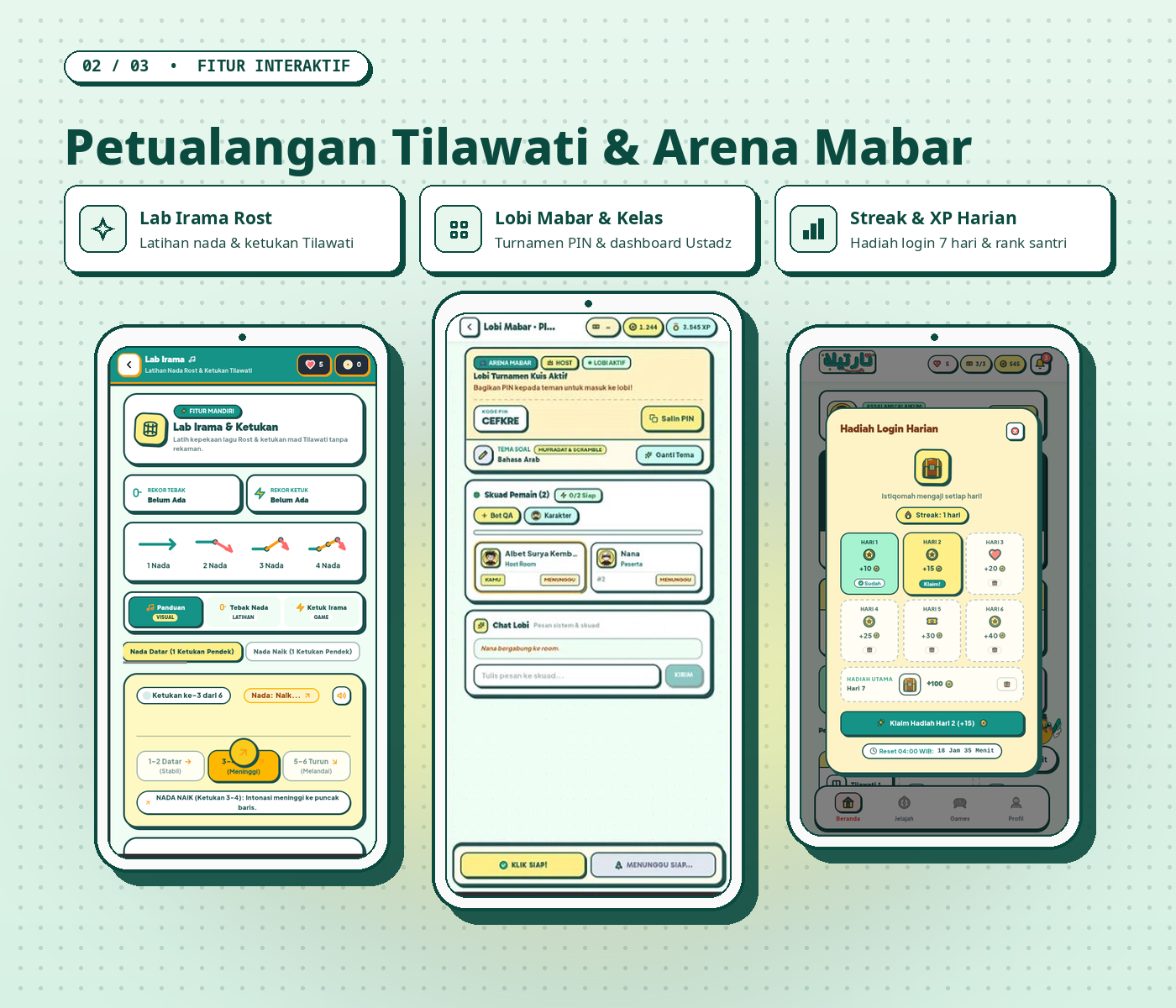
Gamification alone risks optimizing for screen time rather than recitation accuracy. Building a focused Ustadz dashboard directly into the ecosystem ensured teachers can create classroom rooms, track Tilawati mastery, and assign assessments.
The Build
Mascot preferences and learner state hydrate optimistically from Go Fiber SSOT while multiplayer events subscribe safely across channel aliases in useArenaChannel:
// Verified Go SSOT profile & mascot sync contract (tartila/src/services/userApi.ts)
export interface UserProfileResponse {
  mascot_gender?: "boy" | "girl" | string;
  equipped_accessory?: string | null;
  avatar_variant?: number;
  avatar_mood?: "idle" | "happy" | "cheer" | string;
  coins?: number;
  current_streak?: number;
  daily_claimed?: boolean;
}

// Verified Ably multi-channel event aliasing (tartila/src/hooks/useArenaChannel.ts)
const PHASE_EVENT_ALIASES: Record<string, string[]> = {
  phase_changed: ["phase_changed", "match.phase_changed"],
  "match.phase_changed": ["match.phase_changed", "phase_changed"],
};
On the Go Fiber backend (internal/realtime/ably.go & internal/ws/hub.go), authoritative match state broadcasts include sequential eventSeq and stateVersion counters alongside HTTP /state fallback snapshots so refreshing mid-match never leaves students out of sync.
Outcome
- Launched publicly at tartilahub.web.id as part of the Sabil ecosystem, reaching 116+ registered users.
- Delivered structured Tilawati reading flows, customizable vector SVG mascot rooms (Tito & Tila with Framer Motion expressions and cultural/playful outfits), lazy-loaded 2D mini-game hubs (6 released games: Quiz Hub, Harakat Slasher, Tilawati Memory, Ayat Scramble, Hijaiyah 2048, and Hijaiyah Pop), a live Ably/WS multiplayer arena, and an Ustadz assessment dashboard.
- Established repeatable AI-assisted engineering workflows that accelerated feature shipping as a solo builder.
Reflection
Building both lightweight SVG mascot orchestration and lazy-loaded 2D mini-games taught me how quickly per-game sprite sheets and audio cues become the real loading bottleneck. In the next iteration, standardizing a shared audio sprite preloader and asset manifest upfront shaves polish time off every new 2D mini-game.